Tuesday, October 14, 2014

Napoleon's not-so-little Impact

In his time as ruler, Napoleon made a great impact on the social, economic and political systems of Europe. Some loved Napoleon, and some hate him.  Madame de Stael described Napoleon's government as having a "profound contempt for all the intellectual riches of human nature". Conversely, secondary source author P.C. Headley wrote "Napoleon was great -- intellectually towering above the princes and monarchs of many generations....He had no rival in the tactics of war". Whether or not you like Napoleon, it cannot be denied that he greatly changed Europe's social, economic, and political systems. 
First of all, Napoleon's rule impacted Europe's social system. As ruler, Napoleon abolished serfdom and nobility. This meant that poor people didn't have to be poor their entire lives. Serfs would be stuck in their social standing for life, and the nobility were in power, but Napoleon changed this. He also limited the power of the church.  Napoleon established a Meritocracy, in which people had a chance to climb the social ladder through their skills, not because of the social class they were born into. While the nobility may not have liked these changes, it was a great improvement for the poor. The poor got better access to education and property, and the wealthy no longer had power just because of their riches.
Napoleon also greatly affected the economic system of Europe. Napoleon established the Bank of France and balanced the budget of France and his other territories. He controlled prices, encouraged new industry, and built roads and canals, all of which helped the economy prosper. He also stole a great deal of wealth from Italy. 
A map of Europe under Napoleon, 1810
Source: http://www.worldmapsonline.com/images/Cram/History/europeundernapoleon.jpg

Finally, Napoleon impacted the political system of Europe. For starters, he conquered nearly all of Europe, except for England, and brought justice to many people. Marshal Michel Ney said of Napoleon's reign "The times are gone when the people were governed by suppressing their rights".Napoleon made government run better, and allowed people he conquered to continue to rule their country, only under his Napoleonic Code. This was unfortunate for them, but still far better than them being entirely overthrown. Now he ruled nearly all of Europe by controlling the existing rulers. He also gained control of all the colonies that the countries he conquered controlled on other continents. Napoleon changed Europe forever. 

Thursday, October 9, 2014

Chocolate Communism

We entered class last week, the room smelling of chocolate. When we got to our seats we were told not to eat the Hershey's kisses we were given. It seemed everyone was given two, until we noticed that one or two students were given eight chocolates. Upset by the unfairness of this situation, we were given the chance to battle our classmates for their candies in the most complicated battle of wits: Rock Paper Scissors. Each match was for a single Hershey's kiss. Many students went out quickly. I survived for many matches, but still end with less than I started with. The lucky few who started with more chocolate ended with more. Only one person who began with two chocolates ended with more than five. We decided a fair solution would be to redistribute the chocolate evenly, and everyone got three. The two-chocolate students were happy; the ones with more were not. We then voted on whether to eat our chocolate or take it back to Rock Paper Scissors. Everyone chose to eat theirs. While this activity was fun, it was frustrating to lose all my chocolates! So what the heck does this have to do with history?
Our experiences with the Hershey's kiss economy can be applied to the dynamic between rich and poor after the industrial revolution. Karl Marx and Adam Smith both made theories about helping about the poor through different economic systems. Marx's theory of communism described how the poor would help themselves. His theory showed the transition from capitalism to socialism to communism. In capitalism, industry is owned privately and there is freedom of competition, and this results in unequal economic classes. Through a workers revolt, this turns into socialism. In a socialist society, the government owns the industry, and it's goal is to create a equal classes, and ultimately no classes. This becomes communism, and the goal of economic equality is achieved, and no government is necessary. A more detailed description of Marx's theory of communism can be found here. Doesn't that sound all fine and dandy? Before Marx wrote his theory, Adam Smith wrote about what he called the invisible hand. He believed that the best economy was one that guided itself. He describes his theory as an invisible hand. The invisible hand pushed economy in the direction of success through the fact that people want to buy high quality goods for low prices. The economy slowly becomes better and better, and good businesses succeed. This is capitalism. but without government control. Smith believed that the economy functions best without a government. This system would benefit the poor by allowing them to succeed, and find the best businesses to buy from. It also pleases the rich because their money is not distributed.
In my opinion, capitalism is the best solution our of the three, however, all of them have drawbacks. Communism seems to be a great idea, but in reality, it leaves the poor poor, and the rich slightly less rich. Capitalism allows people to grow their own business and buy high quality goods at low prices. However, it isn't perfect, as there are still poor people in America. It is better than Communism, which just doesn't work. It is best for government to allow economy to grow on it's own. Neither method is a true solution, but I certainly cannot come up with a better one.

Sunday, October 5, 2014

To Mill or Not to Mill?: Benefits and Costs of Mill Life

For people who worked in the mills, there were both benefits and costs. The benefits were what made them want to go to the mills, and the costs were made made them strike. The benefits of the mill life seemed very attractive to the farm girls it was sold to. One of these benefits was getting to experience city life. the girls who would work in the mills, for the most part, had never lived with a lot of other people before. This could be seen as an exciting opportunity. The girls would also get an education. Their wages were large enough that they could send some back to their family and still have enough to support themselves. Workers in the mill were provided with meals, so the girls wouldn't go hungry. Finally, a benefit that parents appreciated was the fact the girls would have to obey a code of conduct. A father figure made sure that they went to church on Sunday, and a mother figure made sure that they didn't stay out late. So the mill life was great, right? Not quite.
The rules that had to be followed by the mill workers

Among all these benefits, there were many drawbacks. One cost was being separating from their family. This obviously left many girls feeling sad. Another very important drawback was that the conditions were very dangerous to the health of the girls. The girls were very likely to contract lung diseases, bone diseases, deafness, illness, lose limbs, and even die.  Over the years, hours got longer and wages got lower. Workers could be beaten by their cruel overseers if they did their jobs wrong. Conditions may have been good in the early years of industrialization , but they soon declined, and the costs of going to the mills outweighed the benefits.

Sunday, September 28, 2014

Hanging Out in a Museum 3000 Miles Away

Last Friday, we were informed that on Tuesday we would be having a "Google Hangout" in a museum dedicated to the industrialization of mills in Britain. To prepare for this wonderful opportunity, we did a little preparation work. The man with whom we would be speaking, Jamie, had a video prepared giving us a rundown of what we would see n the mill. We first watched this video to ready ourselves for the video chat. The video walked us through the cloth making process. We noted keywords to look up, including robing, sliver, and slubbing. Then, in our groups we looked up the definitions of these words, so we could ask Jamie questions using the proper vocabulary. We then drafted questions to ask Jamie during the video chat.

Jamie, our explainer

Throughout the chat I learned a lot about the industrialization of the textile industry, especially it's evolution from the cottage industry to the factory system. First Jamie told us about the cottage industry. Before the industrial revolution, families would work their cottages in the country to create cloth to sell. The looms were powered with their feet and fibers would be separated by hand using wire brushes. The fibers would then be put on a spinning wheel. Every member of the family was part of the process. All this changed when the water frame was invented in 1775. The water frame allowed four or more bobbins of thread to be made at once, and it was very important in the transition from the cottage industry to the factory system. The industrialization of machines made work much faster, but also louder and more dangerous. People often went deaf from being around a thousand looms, and accidents were very common. Mills were run for profit, and , as Jamie put it, health and safety didn't exist.

In conclusion, I enjoyed our video chat experience. I thought that being able to communicate with a real person directly was much more effective than watching a video. However, there were issues with lag and choppy signal in the beginning, but these issues fixed themselves. I would definitely like to do another video chat with an expert on other topics throughout the school year.

Wednesday, September 17, 2014

Curating the Industrial Revolution

For two days, my group and I became museum curators. We created an exhibit about transportation during the Industrial Revolution. First we did our research and analyzed all the documents presented to us. We then planned each element of our exhibit. My job was to type descriptions and captions. We also chose which sections of text we would quote, how to describe diagrams, who would print the pictures, who would write out the title, etc. Analysis is an important part of curating, because if you don't analyze your sources, your information could be incorrect! This is bad!! Our clever title was a high point of our collaboration. We hope that people learn about the advances in transportation during the industrial revolution through viewing this exhibit.

My classmate's exhibits-

Condemning the Innocent- An interesting and sad fact that I learned was that almost half of children in mills started work before they were ten. This exhibit made great use of graphics.

Pollution of the Revolution- I learned that at one time, you could barely see an inch through the Thames. This poster had large blocks of text.

Spinning a City- I learned how quickly London's population grew from 1 million to 7 million. The string was a clever touch, and an almond Joy pun was made.


Thursday, September 11, 2014

A Revolution Like No Other

In class we explored details about the advances made during the Industrial Revolution. So what made the Industrial Revolution so... Revolutionary?
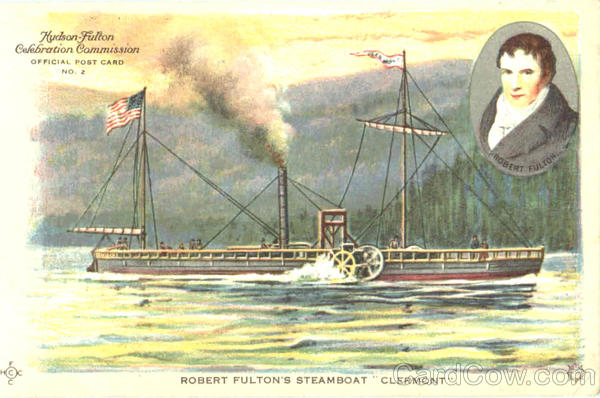
One of the ingredients that made the Industrial Revolution so Revolutionary is the evolution of transportation. The invention of the steam locomotive was important to transportation in the Industrial Revolution. Before the revolution, railroads had to follow rivers so a barge could pull the cars. Now, a steam locomotive would do this. Steam power was also applied to boats by Robert Fulton. His steamship traveled up the Hudson River at five miles per hour. Soon, massive cargo ships were built for ocean sailing. Turnpikes and roads were built, as well as canals. These great leaps in transportation truly made the industrial revolution revolutionary.
Robert Fulton's Steamboat Clermont (http://www.cardcow.com/images/set64/card00301_fr.jpg)

Another thing that helped the revolution on it's way were resources. Britain's large coal supply helped to power steam engines. The need for coal and iron to be mined gave people jobs other than farming. Capital can also be described as a resource. Capital, or wealth, allowed technology to pave the way for innovation. The British economy prospered in the 1600s and 1700s from trade, and this gave the business class a chance to invest in new enterprises, allowing the industrial revolution to happen. Finally, cotton became popular, and demand for cotton clothes, and all textiles, increased. The demand for resources are another that the Industrial Revolution was revolutionary.

Sunday, September 7, 2014

A Google A Day Keeps the Tree Octopi Away

The class activities described in the following blog post were meant to teach the class how to search in an efficient way and use online resources responsibly.
Within the past ten years, Google has become a part of nearly everyone's everyday lives. "Google it" has become a phrase uttered whenever an difficult question arises. Most people probably make at least one Google a day, whether it is to access a website, their email, ask a question, or find a picture or video. Google now provides a trivia service called "A Google A Day" which asks a question, and the user searches the Google search engine to look for the answer. The question, however, has multiple components, making it impossible for the user to just look up the question. They must find out the answers to each component, then answer the question. This concept can be better explained by simply viewing a question at the website. In class, we used this game to learn how to search effectively and use keywords, rather than just typing in a question. It was a fun activity, but some questions posed were very difficult to find the answer to. For one question, I found an answer, but the source that I found it from had apparently misspelled it, and therefore Google did not accept it. I liked the feature of "Deja Google", which prevented spoilers from getting into the Google A Day search results. One thing I learned from this activity is how to use keywords effectively.

Accuracy, Authenticity, and Reliability are all measures of whether or not to use an online source. Accuracy describes the quality of information being clear, concise, precise, and on point. Authenticity describes the source being official, and reliability means the source is dependable and consistent. In class we viewed a website with pages devoted to the The Pacific Northwest Tree Octopus.
Tree Octopus, http://zapatopi.net/treeoctopus/treeocto.jpg
The website seemed lovely, until you realize that the information is all false; the Tree Octopus doesn't exist. The main page of the website says it is "Your Source for Conspiracies and Other Distractions", which is not very scholarly. While the source may have been accurate and reliable, it was not authentic, invalidating its other two traits.  This source is simply an internet hoax, and makes an excellent example for a media literacy lesson.